|   Fantasy News  |   Funny Pics  |   Tamil Movies  |   Hindi Movies  |   Telugu Movies  |   Malayalam Movies  |  

Wednesday, December 8, 2010

The Great Blue Hole of Belize

If you are a diving enthusiast, this Blue Hole in Belize is a must visit spot on Earth.  The Great Blue Hole is located in Belize Barrier Reef Reserve System, about 60 miles away from Belize City. It is believed that this hole is the world’s largest sea-hole. It is about 125 meters deep and its diameter is about 300 meters wide. It has been created as a cause of sea level increase about 65,000 years ago.


This is a popular spot amongst recreational scuba divers, who are lured by the opportunity to dive in crystal-clear water and meet several species of fish, including giant groupers, nurse sharks and several types of reef sharks such as the Caribbean reef shark and the Blacktip shark. Other species of sharks, like the bull shark and hammerheads, have been reported there, but are not regular sightings. Usually, dive trips to the Great Blue Hole are full-day trips, which include one dive in the Blue Hole and two further dives in nearby reefs.


Monday, December 6, 2010

A Lion Can Not Eat A Pangolin

The armour-plated animal that was too much of a mouthful for one hungry lion

When you're a hungry lion, most animals probably seem like a good bet at snack time.

But this lion certainly bit off more than it could chew when it pounced on a pangolin.

British wildlife guide Mark Sheridan-Johnson captured on film this inquisitive big cat which spent a long time trying to devour the odd looking creature in the Selous Game Reserve in Tanzania.

The rare, armour plated pangolin had the perfect defence tactic:roll up into a ball and stay there - whatever happens. 


This looks like a tasty morsel...hmm, it's a bit crunchy...
the lion begins its attempt to feast on the pangolin


Maybe if I use my claws I can get the shell off...wow this thing is tough...
nope, maybe it's time to try a different tactic


The images show how the hapless lion appeared confused by its spherical prey, as it batted the creature about with its paws and even tried to carry it around in its mouth. Mr Sheridan-Johnson, 31, from Newcastle, was showing a group of tourists around the game reserve when he spotted the little pangolin battling for its life.

'The pangolin is an extremely difficult animal to see and is considered by many guides in Africa to be the holy grail of sightings,' he said. 'You can spend your whole life driving round the bush and never see one. 'So when we came across one being attacked by a lion, we could not believe our eyes. 'The pangolin was obviously having a really bad day.'


Hello, is there anyone in there? OK, this is your last chance..
come out with your hands up or, or...
I'll just have to leave you alone and find something else to gnaw on


Oh I give up! That's never happened to me before...
I'm off to find something soft to eat


Pangolins are nocturnal animals and according to Mark, this one was peacefully sheltering in bushes before being smelt out by the two-year-old lion. 'We were all on the side of the pangolin, hoping he would make it out alive,' he said. 'The lion really didn't know what to do with it. She was getting more and more frustrated by the situation.The scales are so sharp that carrying the pangolin around can't have been very pleasant.' The pangolin's shell is made of an organic bony structure called keratin and makes up to around twenty percent of the animal's body weight.

PANGOLIN FACTS


A pangolin is a very rare mammal of tropical Africa. Pangolins are shy and mainly solitary. They are well-armoured with large, hardened, equally-spaced overlapping scales, making them look like a pine cone.

Pangolin know how to protect themselves very well when threatened, by rolling into a ball and erecting their scales pointing upward. The creatures eat ants and termites. Pangolin are thought to be magical - people believe the sight of one will bring them seven years of prosperity. 

When caught by large predators such as lions they work their muscles into a cutting action to lacerate the mouths of their adversaries. The injuries caused can be serious for the animal attempting to eat the pangolin.

Pangolins survive by using their sensitive tongues, which can grow up to 16 inches long, to probe ant nests and termite mounds to eat the insects inside. 'In the end the lion gave up and wandered off in search of something else and the pangolin escaped,' said Mark.

'He stayed in his ball for a long time until it got dark, just to make sure he was safe.' The Selous Game Reserve is Africa's largest protected wildlife reserve and it covers five percent of Tanzania's total land mass. It is located in the remote south east of the country and is made up of gushing rivers, rolling hills and sprawling plains.

The reserve is named in honour of British explorer Frederick Courtney Selous, who wrote a book about his travels in the region and was killed there during the First World War.

President Kennedy - photo from the Archives


Valued Exposure: Watching the lift-off of the first American in space on May 5th, 1961. From left to right, Vice President Johnson, Arthur Schlesinger, Adm. Arliegh Burke, President Kennedy, Mrs. Kennedy. (Cecil Stoughton, White House/ John F. Kennedy Library)

Cut Out Flat Daddys

Flat Daddy, the perfect gift this Christmas for children missing a parent serving abroad with the Armed Forces

For all those children who will be without their fathers - and mothers - who serve in the armed forces this Christmas, one inventive company have come up with the perfect gift: The Flat Daddy.

A Flat Daddy is a life-sized, two-dimensional poster printed on a rollable adhesive-backed material that can be mounted to cardboard, foam, wood, or any other surface to serve as a reminder to children of absent parents that they love them dearly.

‘Flat Daddies and Flat Mommies are life-sized printed posters of parents who are actively serving overseas in the military,’ according to its website.

 Next best thing: A company set up by an American service woman called 
Flat Daddy allows military families to have a life-size replica of their parent in action over Christmas
 DIY Dad: The two-dimensional poster is printed on rollable 
adhesive backed material that can be mounted to cardboard, foam or wood

 Missed loved ones: Families can snap photos with their Flat Daddy 
so they can be part of special occasions and holidays or just a simple day in the park

‘Experts believe the cut-outs are a useful psychological device, especially for children, to help cope with the stress of long absences.  ‘It helps the family stay connected and is a constant reminder that even though mom or dad is thousands of miles away, they are still a part of their lives.’ The company was set up in 2006 by Sergeant Barbara Claudel, who represents Maine National Guard.
Miss you daddy: The life-size image can be put at dinner tables 
so they feel close to their loved one serving abroad
Great idea: The company was set up in 2006 by Sergeant Barbara Claude as a constant reminder that even though their mother or father is thousands of miles away, they are still a part of their family's lives
Biker Dad: Experts believe the cut-outs are a useful psychological device, 
especially for children, to help cope with the stress of long absences.

She was looking for a way to help families stay connected to their loved ones serving in Iraq. And now the idea that is taking off with military families around the country. Marissa Stewart of Seattle, Washington, ordered a Flat Daddy of her husband, Staff Sergeant Jared Stewart, for her three children when he was deployed two years ago. She even started a blog, A Year With Flat Daddy, to chronicle her family's adventures with their two-dimensional replacement.

War zone: But now children don't have to be without their  
mothers and fathers serving abroad, as a Flat Daddy can replace them

‘With an eight-year-old, a five-year-old, and a three-year-old in the house, there’s a lot of stuff to keep us busy,’ the blog reads. ‘We wouldn’t want to leave daddy out, so we flattened him!  ‘Now we take him all the cool (and boring) places we go and snap pictures to keep him, and you, up to date on all the happenings.’

Friday, December 3, 2010

½ a second before tsunami

The last picture! There are people who believe in God, there are others who don't believe, but we must understand that we are small when nature hits...

This picture was taken on the banks of Sumatra Island (the height of waves was of approx. 32 m = 105 ft). It was found saved in a digital camera, 1 ½ years after the disaster. We cannot know for sure, but very likely the one who took the picture is not alive any more (it was just a matter of seconds). Today we can see the last image he/ she saw before ending life on Earth! 


Man loses 20lbs on spud diet

A US man claims he has lost a stone and a half by eating nothing but potatoes for two months.

Chris Voigt, 45, head of the Washington State Potato Commission, said he was also healthier after embarking on his spud diet.

He was protesting against US authorities promoting more diverse school lunch menus replacing potatoes with other vegetables.

Mr Voigt, who was more than 14 stone at the outset, said that by eating only potatoes he had lost a stone and a half.

He also reduced his blood sugar level and his cholesterol dropped by more than one third, reports the Daily Telegraph.

He said: "I absolutely feel great. I've always had lots of good energy on this diet, I've had no strange side effects, I sleep well at night."

During the diet he consumed 400lbs of potatoes, about 20 individual vegetables a day.

He ate them boiled, mashed, sliced, fried and roasted. On Thanksgiving he crafted mashed potato into the shape of a turkey and carved it.

Mr Voigt accepted that a diet of just potatoes was not sustainable in the long term but said his experiment had shown how "truly healthy" the vegetable is.

He celebrated the end of his 60-day diet with a meal of fajitas and tacos - and some grilled potatoes.

Jaw-Dropping Images Of Enormous Clouds

Eye of the storm: The jaw-dropping image of an enormous 'supercell' cloud

It looks like something from the film Independence Day. But although it may seem like an alien mothership, this incredible picture is actually an impressive thunderstorm cloud known as a supercell. Windswept dust and rain dominate the storm's centre while rings of jagged clouds surround the edge. A flimsy tree in the foreground looks like a toy next to the magnificent natural phenomenon.

Awe: This massive supercell shows a column of rain in the centre of thick clouds


The photograph is just one image from the portfolio of electrician Sean Heavey. The supercell cloud was photographed in July west of Glasgow, Montana, USA.

Mr Heavey, 34, an amateur photographer, created the jaw-dropping panoramic image by stitching together three photos from the 400 frames he took of the violent scene he witnessed in July

It caused minor damage, and lasted several hours before moving on. Massive storm systems like this centre on mesocyclones -- rotating updrafts that deliver torrential rain and high winds.

The dangerous outbreak of weather raged for several hours and caused minor damage to local communities - while watchful Mr Heavey captured all its devastating beauty from a distance.

Taking photographs of storms for the past seven years, this year Mr Heavey and his masterpiece are up for a prestigious award from National Geographic.

Called the 'Mothership', because of the striking image's similarity to an alien space ship, the photograph was actually four years in the making.

'I have two storm chasing friends I met through my wife Toni and they've been badgering me to go out with them for that long,' explained Sean.

'I' normally rely on simply being in the right place at the right time for my photography, while I'm out working. But in July I finally decided to do it and thankfully this picture was the result. We don't usually get weather like this out in Montana, it felt like the perfect storm.

'The power was awe inspiring.'

A super cell thunderstorm crosses a path and continues unabated across the plains on July 28th

A storm descends in July 2007 over the sleepy town of Glasgow, Montana


'I felt that if you could walk inside the rain and the wind right into the centre of the storm and stare up, then it would have been like looking into God's eye.'

Known as the 'mother of tornadoes', a mesocyclone can be up to six miles wide and can produce as many as 60 tornadoes.

These severe thunderstorms form where cold dry air meets warm moist tropical air.

The wind coming into the storm starts to swirl and forms a funnel. The air in the funnel spins faster and faster and creates a very low pressure area which sucks more air - and objects - into it.

If the cyclone runs out of wet, warm surface air, it dies out. If it does not run out of this fuel, however, the rotating cloud stretches toward the ground and may become a giant tornado.

Mr Heavey, 34, is an electrician, working in the west of the American state in a town named Glasgow.

Taking photographs of storms for the past seven years, this year Sean and his masterpiece are up for a prestigious award from National Geographic.


The super-cell storm begins to build - before unleashing a powerful torrent of rain down onto a Montana field
The belly of the thunderstorm as it begins to wreak havoc


Photographer Sean Heavey, who has spent the last four years taking 
beautiful and striking storm pictures, and an image of a lightning bolt in the middle of the storm


'The 'Mothership' picture is a super-cell storm that was around five to ten miles in diameter with hurling winds of around 85 mph,' said Mr Heavey, who moved from bustling Seattle to sleepy Montana for a quiet life four years ago.

'I photographed it for over two hours as it traveled between Glasgow and the town of Hinsdale.

'I can honestly say that the photograph does not do it justice. I caught the shot just as the sun was setting which brought out the colours so vividly.

'I felt that if you could walk inside the rain and the wind right into the centre of the storm and stare up, then you would be able to see God's eye.'

As an amateur photographer, storms have been Mr Heavey's obsession since he was caught under a huge thundercloud on a visit to relatives in Ohio, which is part of America's famous 'tornado alley'.

'I felt the sheer power of that storm as a young boy and I am not ashamed to admit that it scared the living daylights out of me,' he said.

'Since I moved to Glasgow I travel a lot in my job as a electrician. The clients that I visit are well aware that I carry my camera with me over the state and they are more than happy to help point out gathering storms on the horizon which they think will be great subjects for me.'


A shelf cloud passes overhead as the super cell storm looms ominously in the sky

Rain feathers dancing across the western prairie in August 2010, in Glasgow, Montana
Like scenes of the apocalypse these incredible images are 
the stunning results of one man's mission to capture stormy skies on camera

Thursday, December 2, 2010

Curious Elephant

Two women were given the nature close-up of their lives when a wild bull elephant approached their veranda as they sat out in the sun. And quick-thinking photographer Marsel van Oosten made the most of the rare situation by capturing a holiday snap to remember. He was staying at the Lower Zambezi National Park in Zambia with his wife, Daniella Sibbing, when the African elephant came to introduce himself. As Daniella and lodge owner Lana De Villiers sit motionless, for fear of being trampled, the 43-year-old aimed his camera and took the breath-taking shot of the beast.

 Dangerous: Photographer Marsel van Oosten waits for the African bull elephant to look up before snapping the photograph, only three feet from his veranda
 Happy snappy: Dutch photographer Marsel van Oosten poses in the 
wildlife next to another bull elephant in Zambia
'The camp is located on the banks of the Zambezi River and set in a grove of Acacia trees which tower above the massive bull elephant that love feeding on them,’ said Dutchman van Oosten. 'They especially like the pods that fall from the trees and they actually shake the trees so that more pods fall down. 'The elephant in this shot was picking up the pods that were all over the camp, and slowly moved into the direction of the veranda. 'It was the elephant that decided to move closer to the people, instead of the other way around - that was what made this such a special, if not slightly nerve-wrecking, experience. 'This is a wild elephant, and all wild animals are potentially dangerous. You should never try to get this close to an elephant.'
 Big reception: The herd come marching though the Elephant Hotel reception
- as they do every year, on the hunt for food
 Welcome: An African elephant wanders through the Elephant Hotel in Zambia, 
as a herd do every October, as it's a traditional route
He added: 'I was reorganising my camera bag and cleaning my gear because it can be very dusty at times. 'When I saw the elephants approaching, I initially didn't see much of a photo opportunity as the light was getting quite harsh. 'But when this one elephant started to get closer and closer I quickly took my camera and positioned myself behind the women, hoping for the elephant to walk into the frame. 'When it was only a metre away, it looked up to check out the situation and that was when I took this shot.'
 Traditional: The inside of the venue forms part of a 
traditional trail used by an elephant family for several years

It's a similar story at the Mfuwe Lodge in South Luangwa National Park, also in Zambia, where the elephants are more regular visitors. The inside of the venue forms part of a traditional trail used by an elephant family for several years. The unique spectacle occurs as up to 10 colossal African elephants stroll through reception on their way to their favourite mango trees inside the hotel compound. Hotel developers in 1998 unwittingly built the hotel on the well-trodden route favoured by the elephants - but it was of little importance to the powerful animals who simply walked through the building like they were guests.  The herd marches to the hotel - and through it - at the end of October every year when the fruits ripen.

Futuristic Flying Car

The futuristic flying car that's a helicopter and a plane AND a Humvee

It looks too far-fetched to be anything but a child’s toy. But for front-line troops in Afghanistan, this revolutionary vehicle could soon be a reality. The road-going army truck turns into a helicopter at the touch of a button, allowing it to fly above hazards such as roadside bombs.

 Take-off: A concept design for the Transformer vehicle which will be able to fly troops safely over areas littered with roadside bombs
 Convertible: The vehicle's wings fold away so it can operate like any other armoured car
 Parts for the futuristic vehicle will be developed by a number of different military hardware firms

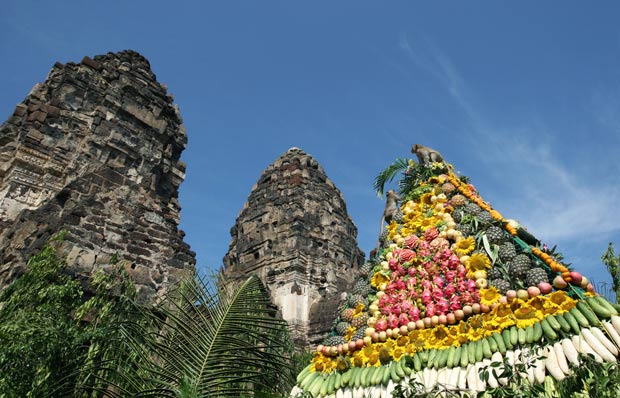
Monkey Buffet Festival

Macaques eat at a buffet during the Lop Buri Monkey Festival at a temple in Thailand

 Every year the people of Lop Buri hold a party for the hundreds of macaques that live around the Khmer temple- Prang Sam Yot. The annual monkey festival takes place in the last weekend of November and is a major attraction for locals and tourists

 The monkeys have become such a part of the local life that the party is held to thank them for drawing tourism to the town

 Prang Sam Yot temple in Lop Buri is 150km (94 miles) north of Bangkok, Thailand
 Last year the monkeys got through around 2,000 kilograms of food provided by locals who believe donating the food will bring them good fortune


Related Posts Plugin for WordPress, Blogger...